Is two hours the recommended limit?
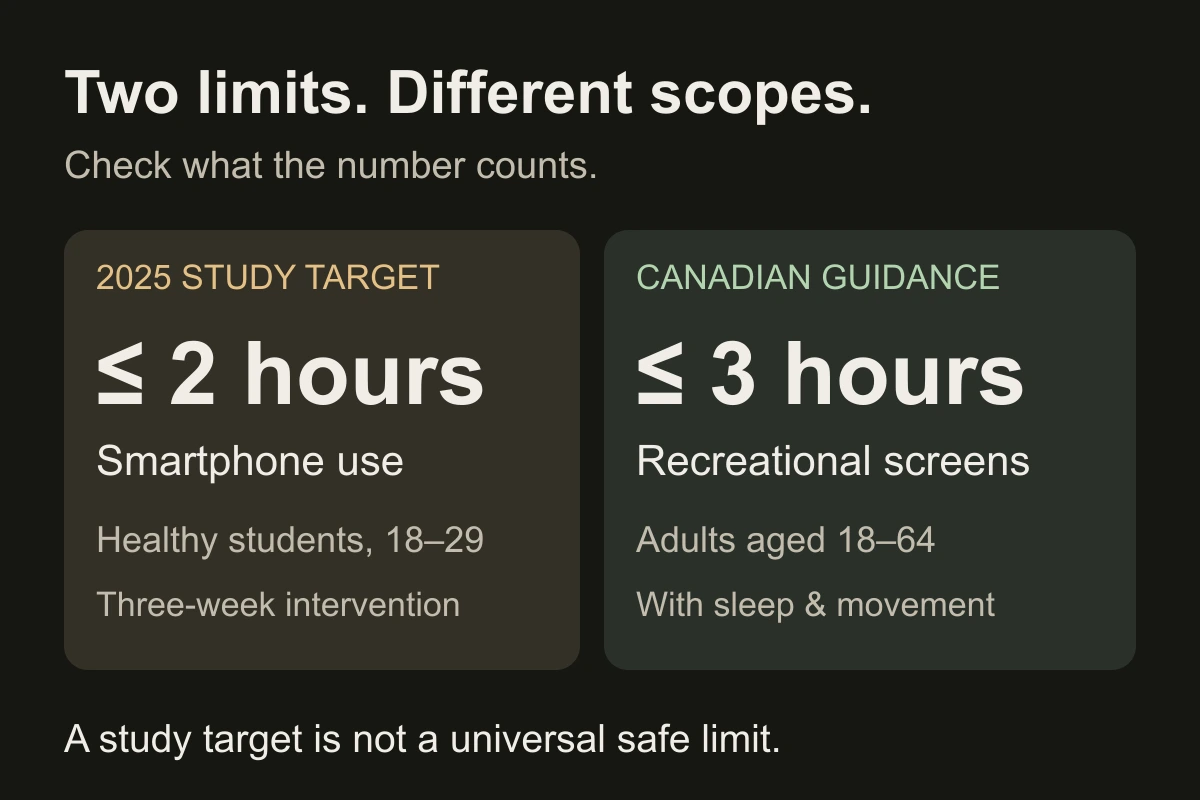
Ask what the number counts. The Canadian 24-Hour Movement Guidelines advise adults aged 18–64 to keep recreational screen time to no more than three hours daily, alongside sufficient sleep, physical activity and less sitting.
That refers to leisure across screens, rather than all computer work. It is guidance within a whole-day movement framework, not a diagnosis or a guarantee that every shorter session is harmless.
What did the two-hour study test?
A 2025 randomized trial assigned 111 healthy students aged 18–29 to usual use or a target of at most two hours of daily smartphone use for three weeks. Researchers collected usage screenshots and questionnaires about stress, depressive symptoms, insomnia and well-being.
The reduction group improved on these measures after the intervention. Usage rose again afterward. Participants knew their group, mental-health outcomes were self-reported, and the sample does not represent all adults.
This supports testing a reduction; it does not establish two hours as a universal safe limit. It measured smartphone time, whereas the Canadian guidance counts recreational screen time.
Look at what the total is hiding.
Review your activity report with three questions:
- Which sessions were necessary or worthwhile?
- Which continued after you wanted to stop?
- What did those sessions replace: sleep, a task, movement or time with someone?
Keep useful access available. A work-heavy day and an evening of unwanted scrolling need different adjustments, even if their totals match.
Try one boundary for the coming week.
Choose one session to change, such as the feed you open after getting into bed. Give it an ending and prepare an alternative: a book, music or a conversation.
For a week, note the minutes and whether the activity you wanted to protect happened. Adjust a boundary that blocks essential tasks. This is a practical self-check, not the study protocol; use our goal-setting guide if you need a smaller starting point.
Close the tab. Try this.
One small action.
Tonight, identify one screen session you would like to shorten. Write down its stopping point and what you want to do with that time instead.
Check what the minutes mean. Choose a boundary that gives something useful back to your day.
Sources & context
- Canadian Society for Exercise Physiology — adults aged 18–64 ↗
Official Canadian guidance integrates physical activity, sedentary behaviour and sleep. Its three-hour target concerns recreational screen time. The guideline notes that pregnancy, disability or medical conditions may require tailored guidance.
- Pieh et al. (2025) — Smartphone screen time reduction improves mental health ↗
Original non-blinded randomized trial in 111 healthy students who used smartphones at least three hours daily. Screenshot-based usage, self-reported outcomes, possible use of other devices and follow-up attrition limit interpretation. It tests neither every adult’s ideal limit nor this article’s exercise.
Written by EvoCat, the app’s publisher. Educational guidance, not medical advice. Our editorial approach · Suggest a correction
Put a boundary into practice
Put your chosen boundary into practice.
Use EvoCat’s schedules or daily app limits to protect the time you choose on iPhone and iPad. A free trial is available for eligible subscribers, with a paid subscription afterward. Check the trial and renewal terms in the app.
Download EvoCat for iPhone ↗